
Home / Auditing
02 · Auditing services

Audits that end in evidence, not opinions.

Independent audits against ISO 9001:2015, ISO 9001:2026, AS9100D and your own procedures. Every finding cites the requirement, the objective evidence and a grade, and goes into a corrective action log you can close out.

Audit types

Four ways to test your system.

ISO 9001 9.2 · AS9100D 9.2

Internal audits

We run your internal audit program, or audit alongside your own auditors while they gain experience. Useful in small companies where it is hard to find auditors who don't audit their own work (ISO 9001 9.2.2 c).

  • Risk-based audit program and 12-month schedule
  • Process audits with a clause-by-clause checklist
  • Written report, corrective action log and follow-up verification
Clauses 4–10

Gap assessments

A structured review of current practice against every applicable clause: interviews, a floor walk and record sampling, then a written report.

  • Clause-by-clause status: in place, partial or missing
  • Documented information checklist (maintain versus retain)
  • Prioritized action list with owners
  • Timeline and effort estimate to certification
ISO 9001 8.4 · AS9100D 8.4

Supplier audits

Audits of your suppliers and outside processors against your purchase requirements, flow-down clauses and the applicable standard, onsite or remote.

  • Audit plan built from your approved supplier list and risk
  • Findings that can be issued as supplier corrective actions (SCAR)
  • Report to support supplier approval and re-evaluation
Stage 1 · Stage 2

Mock certification audits

A full pre-certification run-through in the format of a registrar audit, so your team has answered the questions once before it counts.

  • Opening and closing meetings, interviews and record sampling
  • Findings graded the way they will be reported
  • Readiness summary ranked Major, Minor and OFI
Finding grades

One scale, used the same way every time.

Every finding names the requirement, the evidence and the grade, so it can be closed without a debate about what was meant.

Major

A requirement was not met and the system broke down, or nonconforming product could reach the customer. Needs a corrective action.

Minor

A requirement was not met in a one-off lapse. Needs a corrective action.

Observation

Not a nonconformity yet, but could become one if left alone.

OFI

Opportunity for improvement: the requirement is met, and it could be done better.

Audit records

Programme, findings and follow-up in one place.

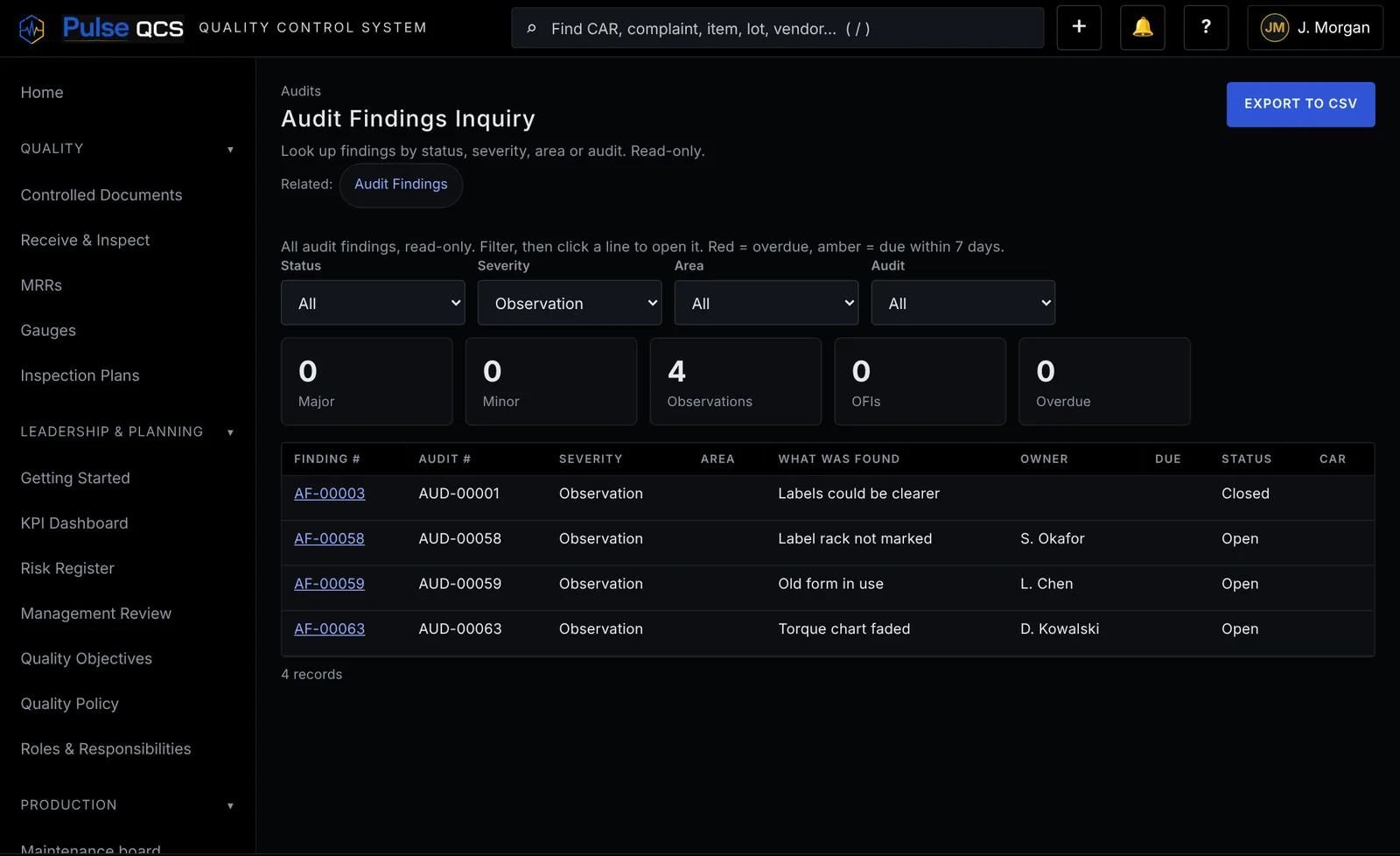
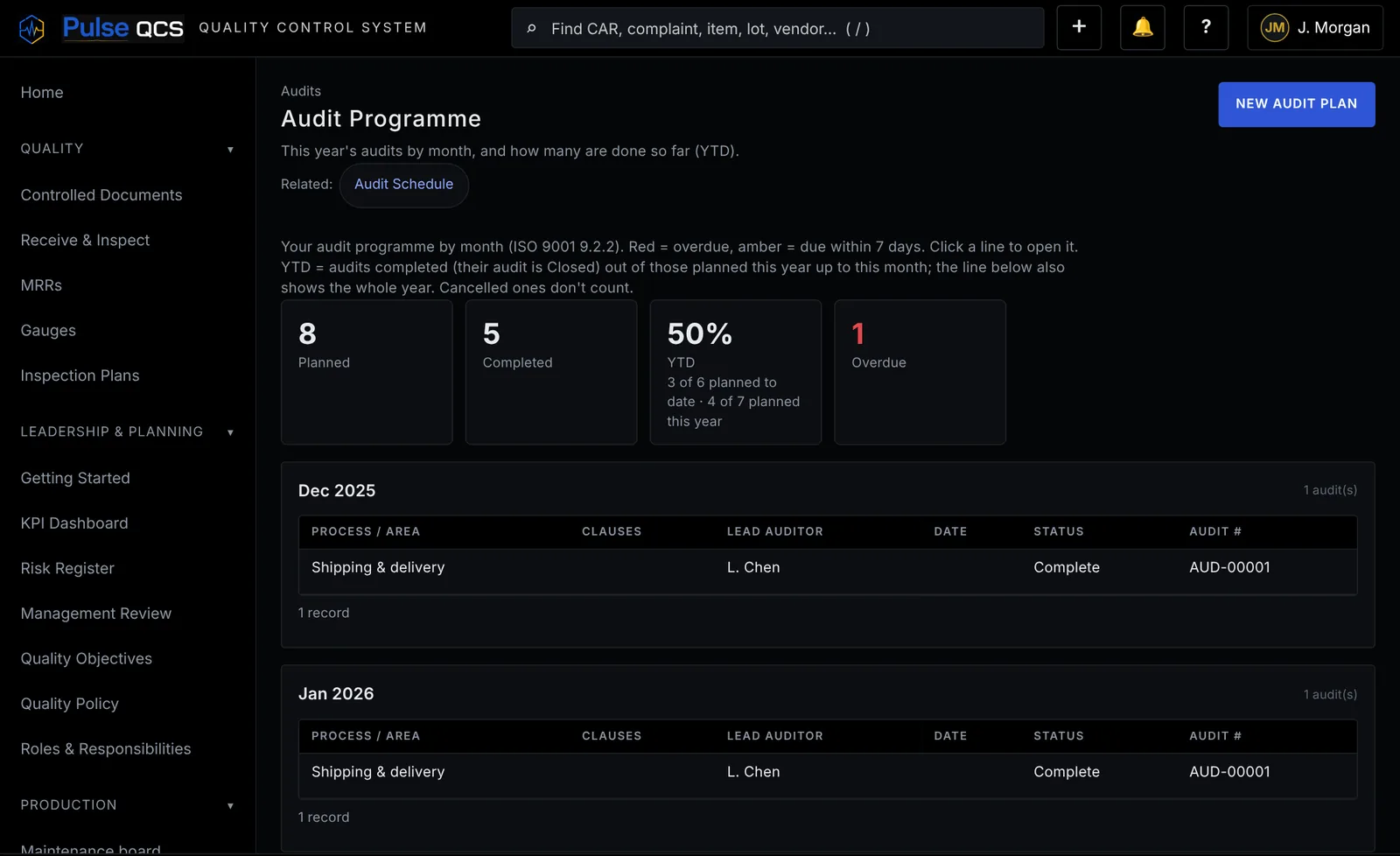
When you use Pulse QCS, audit programmes, schedules, findings and the CARs they raise live in the same system as the rest of your records, with links in both directions.

  • Audit programme by month: planned, completed, overdue
  • Findings inquiry by severity, area and audit
  • Major and Minor findings linked to their CARs
Pulse QCS audit programme by month
Pulse QCS audit findings inquiry filtered to observations
ImpartialityPulse QCS does not issue certificates. An auditor does not audit work they built or run for the same client.
Next step

Audit coming up?

Send the audit type, the standard and the date the report is due.

Schedule an audit →